


Zumba: The Rhythmic Revolution of Fitness Branding
Zumba, the global fitness brand that seamlessly blends Latin dance and aerobic workouts, has become a worldwide phenomenon. Despite a lack of attention from the business community, Zumba has tapped into evolving trends in fitness and music to build a brand valued at millions. This case study will dive into Zumba's founding story, its innovative approach to growth, and the key factors that have contributed to its entrepreneurial success.
By Vincent Fucetola
In the mid 1980s, in Cali, Colombia, Beto Perez, a 16-year old fitness instructor, faced an accidental mix-up that changed his life. While preparing for an aerobic class, he accidentally left behind his usual playlist of American pop hits. In a moment of improvisation, he decided to use a mixtape he had in his car, filled with energetic Latin songs, salsa, and merengue. The class's reception to this tape was overwhelmingly positive, as students found the Latin-infused workout both invigorating and enjoyable. Recognizing the appeal of this unique fusion, Perez decided to build on this novel approach, ultimately giving birth to the global fitness phenomenon known as Zumba.
Strapped with a new fitness concept, Perez set out to build a brand. He initially release exercise videos that reached a wide audience. However, Perez took an unconventional approach by shifting his focus towards training instructors. His idea was to empower instructors to spread Zumba within their communities. This led to the creation of the Zumba Instructor Network, a subscription portal offering class plans, music, and merchandising opportunities.


The Branding Genius
A Fusion of Cultural Trends: Zumba's brand sits at the intersection of several dominant cultural trends, including Latin culture, social networking, globalization, weight-consciousness, feminization, and solo entrepreneurship.
A Unifying Vision: Similarly to the previous founding stories that we have dissected, Zumba's brand identity is built on a unifying vision. Alberto Perlman, one of the co-founders, states that their purpose is "to change lives through health, wellness, and overall happiness." The sweeping vision resonates with the essence of Zumba culture itself, encapsulated in "FEJ" (freeing, electrifying joy), which serves as a rallying cry and cultural touchstone for Zumba users worldwide.
The Power of Music: The fusion of Latin dance and aerobic workouts, combined with a soundtrack of lively and rhythmical music, creates a fitness experience that not only motivates participants but also makes them look forward to each session. Zumba has harnessed the universal language of music to engage and captivate a diverse global audience. the infectious beats and melodies have not only made the workout sessions enjoyable but have also turned Zumba into a global cultural movement.
Our Key Takeaways
Innovate at the Intersection of Necessity and Opportunity: Zumba's founding story highlights the power of seizing unexpected opportunity that arises from a seemingly trivial mix-up (remember out Warby Parker story in the last edition). Entrepreneurs and founders find success by embracing unforeseen situations, recognizing the potential in those situations, and quickly innovating in response.
Empower Your Community to Promote Your Brand: Zumba's shift from targeting class-goers to training instructors empowered a network of Zumba enthusiasts, who in turn became no-cost brand ambassadors. Consider unconventional approaches to engage and mobilize communities to spread your message.
Create a Cultural Zeitgeist: Much of Zumba's success lies in its ability to tap into culturally relevant trends. Context, and showing up in the right way in multiple contexts, is key to brand building. Align with cultural shifts and ensure your brand embodies the prevailing spirit of the current.
Netflix - The Race to Innovate
By Jack Ghannam
Though it is known as the most popular and efficient streaming service, Netflix wasn’t always the iconic media brand that they are thought to be today. Starting back in April of 1998, Reed Hastings, Netflix CEO and Founder, rented a movie from Blockbuster. He realized that after not returning the movie, he was charged a $40 late fee, on top of having to pay for postage back to a Blockbuster location. In this moment, Hastings made it his mission to create a streaming service without postage charges or late fees. Hastings took the old Blockbuster business model and transformed it into a streamlined direct to consumer model, and there was born Netflix. With Netflix, consumers can simply add movies to their “wish list” and have a new film sent to them in the mail from their wish list once the previous film has been returned. This creates a constant stream of films coming to consumers and allows for them to build Netflix into the customer’s routine.
This extremely personal way of connecting with customers is exactly why Netflix has taken off. First with their mail-in-movies, and now with their digital streaming. Being able to tailor to your customer’s current interests on a consistent basis is why Netflix has such a dedicated and loyal subscriber base. After just 9 years from its launch, Netflix had accrued $49 million in net income, with nearly a billion dollars in revenue. With 6.3 million subscribers, and over 42 million discs to send to customers, Netflix was supplying films via mail to every state in the country. However, this growth could not be sustained, and with a digital age booming in the early 2000’s, Hastings and his team needed to pivot to a more operationally effective format.
Netflix’s long-standing competitor, Blockbuster, started to move into the online retail space, something that Hastings knew Netflix had to push towards as well. In 2006 and 2007, Blockbuster used their online site to allow customers to pick up and drop off films at their Blockbuster locations, after choosing online; allowing for customers to rent a movie immediately. With the instant gratification aspect of Blockbuster’s developing business model so great, Blockbuster quickly acquired 2 million users on its platform: leading many to believe that this is the most efficient and effective way to turnover inventory and grow a customer base.
Seeing the growth and effectiveness of Blockbuster’s new business model, Netflix quickly took to the online space as well. In January 2007, Netflix launched its website and digital service, converting all mail-in-order subscribers to website subscribers, moving their medium online. This took almost $40 million to properly pull off, however this business model started to take over. Known as Video on Demand, Netflix was able to present customers with a film catalogue and rent instantly from their website. By digitizing the entire process, Netflix is able to give customers a greater array of films to choose from as well as lower inventory costs via digitization of previously physical copies of films. This increased Netflix’s revenue, cashflows, and net income, growing Netflix into the brand we all know and love today.
Takeaways for College Students:
1. Appealing to Peers and Companies
As students, we generally do not have much professional experience, and neither did Hastings when diving into the digital media space. Hastings made it clear he wanted to do make the customer’s life as easy as possible, making his site more appealing and accessible. As a college student – this is your key: how can you make someone’s life easier? Customers and employers alike are not looking to pay/hire someone who doesn’t bring them value, you need to make sure that you are eloquent and persistent about the value that you provide to an organization.
-
Hasting’s value proposition is clear, he can offer customers the best-in-class digital streaming services. What can you offer to customers, companies, employers, and peers? Make your value clear, and finding a job, internship, or a network will become that much easier.
2. Rome Wasn't Built in a Day
Greatness takes time. It also takes patience, dedication, and persistence – something that many people overlook in the modern world. However, being able to “play the slow game,” is key in business. Hastings faced several challenges, several risky capital expenditures, as well as pressure from one of the biggest brands in the world. Hastings took almost 30 years to get Netflix to how we know it to be today. By slowly making changes in the right direction, Hastings was able to properly hedge his risk, play the market, and evolve in an effective way. You cannot rush an assignment the same way you cannot rush a company to #1, because it takes time to develop, evolve, and achieve growth in an effective and sustainable way.
3. You are Your Own Personal Brand
Netflix’s recent growth (past 2010) is largely due to their branding and positioning. With a reputation among movie-lovers as the best platform to stream films, much of their valuation and growth as of late can be attributed to their brand. As a college student you need to sell yourself to employers and internships in order to get a position that you are hoping to earn. Your personal brand is what employers look at: this consists of your personality, experience, growth, skills, leadership, and grade effectiveness. These attributes make up your personal brand and your reputation. Your growth can be positive due to your personal brand such as the case of Netflix, but you need to know how to convey your brand and reputation to customers, employers, and internships.
Business Takeaways:
1. Proactive Planning
Reed Hastings knew that Blockbuster was the company that he needed to surpass in order for people to want to use Netflix. After over nine years of analysis, watching markets, and seeing the digital revolution, Hastings knew that moving online was key. Furthermore, when Blockbuster digitized, Hastings proactively found the holes in Blockbuster’s operation. This helped him plan out his own website and offer more to customers in terms of convenience than that of Blockbuster. This is what set him apart from Blockbuster, causing a favorably disproportionate growth in Netflix’s valuation.
2. Evolving Constantly
With Blockbuster claiming nearly 2 million subscribers on their site, Netflix needed to alter their business model in order to maintain market share and their customer base. Hastings took the risk of investing $40 million into his website, which in the end, was the best $40 million he had ever spent, easily fostering billions in revenue each year. Sometimes you need to take risks in order to stay afloat, and if Netflix hadn’t taken that risk of digitization, we may not be using Netflix to watch our favorite movies and television shows today.
3. Operational Effectiveness - Netflix's Competitive Advantage
With any digital retail medium, customer experience is key to fostering growth and retention. Making sure that the customer has the best experience possible on Netflix as opposed to Blockbuster was Hasting’s goal. The main pillar of this effectiveness in terms of experience for the customer is making the entire viewing process as quick and painless as possible for the customer. With Video on Demand, Netflix simply blew Blockbuster out of the water, dominating the efficiency and ease for customers to find a film, pay for it, and receive it in a matter of minutes. This is simply a process that Blockbuster did not have built into their site, which is why they closed their doors recently, being surpassed by Netflix
_edited.jpg)
"Companies rarely die from moving too fast, and they frequently die from moving too slowly."
Reed Hastings, Netflix Founder & CEO
Bill Walsh: The Score Takes Care of Itself
By Vincent Fucetola
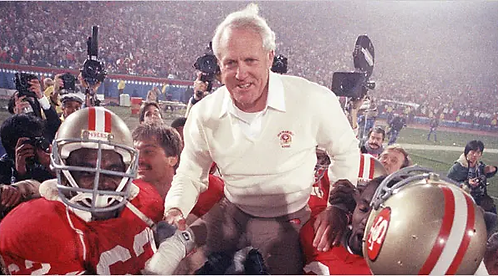
"The Score Takes Care of Itself: My Philosophy on Leadership" is a book written by Bill Walsh, a renowned American football coach. In this book, Walsh shares his philosophy on leadership, which he developed during his successful coaching career, particularly during his time as the head coach of the San Francisco 49ers. The book provides a comprehensive guide to leadership principles that are not only applicable in the world of sports but in various aspects of life and business.
The central theme of the book is that a relentless focus on high standards, attention to detail, and meticulous preparation are the keys to achieving success. Walsh emphasizes that true leadership not only involves setting an acute vision but also creating a culture of excellence that permeates throughout an organization. Below is a synopsis of Walsh's book, as well as key business takeaways:
The Standard of Performance: Walsh's standard of performance consists of specific, high expectations and principles. It emphasizes the importance of consistency, preparation, and attention to detail.
Takeaway: Establishing a clear and comprehensive set of standards is crucial for creating a culture of excellence. These standards should cover all aspects of an organization's operation and serve as a guide for decision making.
The Score Takes Care of Itself: Here lies the central philosophy of the book. Walsh contends that if you consistently focus on doing the right thing and adhering to the standards that you have previously set, success will naturally follow.
Takeaway: Success is a byproduct of doing things the right way. It is not achieved separately from it. Focus on the process, and the outcomes will take care of themselves.
Performance-Relationship Balance: Walsh emphasizes the importance of both demanding high performance and maintaining positive, respectful relationships within the organization. He believes that they are not mutually exclusive.
Takeaway: Achieving success is not about being ruthless; it’s about striking the balance between performance expectations and nurturing positive interpersonal dynamics.
Legacy and Reflection: In the final chapters of his book, Walsh reflects on his life, career, and the lasting impact of his leadership philosophy. He underscore the importance of leaving a positive and lasting legacy.
Takeaway: Your legacy is a direct reflection of the principles that you choose to live by and the impact that you have on others. Building a positive legacy should be a central focus of one’s life and leadership choices.
In the realm of business and entrepreneurship, Bill Walsh's book, "The Score Takes Care of Itself," underscores that success hinges on the relentless pursuit of excellence, diligent adherence to high standards, effective leadership, and unwavering commitment to a well-defined process. By applying these principles, business leaders and entrepreneurs can cultivate a culture of excellence, assemble high-performing teams, and significantly enhance their prospects for long-term success and growth in their specific industries and competitive markets.
How I Built This with Guy Raz: Threading the future of circular fashion with Peter Majernowski
By Rosaly Gutierrez
"Over 100 million garments will be produced this year, but they don't have to be." Peter Majeranowski says we have all the clothes we need to make all the clothing we’ll ever need, and his company Circ, has pioneered the technology to prove it. This week on How I Built this Lab, Peter shares how trying to create fuel from tobacco unintentionally led to the creation of a different material – pulp that could go back to the beginning of the supply chain and close the loop on fast fashion. Plus, the future of sustainability in the industry and the impact brands can have on the environment simply by changing their fabric sources.”

In this episode, Peter Majeranowski shares his journey from a career in the Navy and defense industry to becoming the co-founder and CEO of Circ, a sustainable fashion company.
Peter's career started in the Navy, where he served during significant events such as the 9/11 attacks. Later, he worked in Eastern Europe for a defense industry management firm. He begins the episode by highlighting the significant problem of textile waste in the fashion industry, with 92 million tons of textile waste being generated each year. Peter Majeranowski saw this as a challenge that needed a solution.
Takeaway: Majeranowski recognized a problem in the fashion industry: textile waste. Entrepreneurs should keep an eye out for pressing issues that need innovative and practical solutions. If you’re in college for accounting, no one says you cannot go into fashion. Your future is not determined by what you studied. Study more if you have to.
Peter initially founded Titan Biosciences, aiming to turn tobacco into biofuels. However, he shifted the focus of the company to textile recycling when he discovered a breakthrough technology for efficiently recycling poly-cotton textiles. Circ's technology can break down poly-cotton textiles into high-purity cotton and polyester building blocks, which can be used to make new clothing.
Takeaway: Majeranowski pivoted the company to Circ when he discovered a way to recycle poly-cotton textiles efficiently. Entrepreneurs should be open to pivoting their business model when a better opportunity arises. Change is inevitable. Be prepared to leave your original idea behind but never, ever the motivation to make a change in the world.
Circ partnered with well-known brands like Zara and Patagonia to incorporate recycled materials into their clothing lines. This collaboration allowed Circ to gain credibility and exposure. The company raised significant capital, including investments from Bill Gates' venture fund, to scale up operations and build large-scale recycling facilities.
Takeaway: Entrepreneurs often need significant funding to develop and grow their sustainable solutions. Collaborations with established brands can provide startups with exposure and credibility. Do your research. There are thousands of people who are willing to invest millions of dollars money in new business ventures.
While recycling materials is a step toward sustainability, there are ongoing challenges related to water usage, dyeing processes, labor practices, and greenhouse gas emissions. Changes in regulation are expected in the textile recycling industry, similar to the paper recycling industry, as the fashion industry faces pressure to become more sustainable.
Takeaway: Entrepreneurs should consider the full lifecycle of their products and aim for comprehensive sustainability solutions. Aim to be efficient. Don’t take the earth for granted.
Circ's story demonstrates the potential for disrupting well-established and optimized industries with innovative solutions. Entrepreneurs should look for opportunities to disrupt traditional practices and transform industries. Everyone has the potential to change the world. Don’t let your lack of knowledge or experience deter you from creating something groundbreaking.

California's New VC Diversity Reporting Law
Panera Bread, the popular bakery-cafe chain, is preparing to go public again after a nearly five-year hiatus as a private company. "Panera Bread was a public company for over 25 years until it was taken private in 2017 by European investment firm JAB Holdings in a $7.16 billion deal." During its time as a public company, they were a high-growth performer, with its stock price increasing by more than 800% between 1997 and 2017. The company was known for its innovative use of technology, such as its digital ordering system and loyalty program.
Panera Brands is making several changes to improve its efficiency and profitability in preparation for its second IPO. The company is laying off 17% of its corporate staff, focusing on support roles. The layoffs signal that the company is serious about preparing for an IPO. Panera Brands is also streamlining its operations by combining its three brands, Panera Bread, Einstein Bros. Bagels, and Caribou Coffee, into a single company.
In addition to these operational changes, Panera Brands is also making some executive changes. Niren Chaudhary, the current CEO of Panera Brands, will be succeeded by Jose Dueñas, the CEO of Einstein Bros. Bagels. This change is seen as a way to bring fresh leadership to the company as it prepares for its IPO.
Panera Brands is confident that it is well-positioned for success as a public company once again, based on its past performance and current strategies. The company has a strong track record, with revenue of 4.8 billion in 2022. They boast a loyal customer base with 44 million members in their loyalty program, compared to Starbucks and Chipotle, which have 23 million and 20 million, respectively. And a strong leadership team in which their spokesperson said they have "made some difficult decisions to better align our support structure with our strategy," Additionally, the company is also facing favorable industry trends.
Cava, another fast-casual restaurant like Panera, raised $318 million in its IPO earlier this year while trading at over double the amount of their initial public offering. Overall, restaurant IPOs are doing well in 2023 for many reasons. The first is the growth and recovery of the restaurant industry after a decline in sales of almost 20% in 2020. Secondly, the resilience of the restaurant business to inflation pushes investors looking for new and long-term growth investments to turn to restaurants.
On October 9, 2023, California made a groundbreaking move by becoming the first state in the U.S. to pass legislation that aims to increase diversity within the venture capital industry. This law, known as Senate Bill 54, will take effect on March 1, 2025, and will mandate that venture capital firms in the state annually report the demographic information of the founders that they are backing.
In 2021, Forbes highlighted the severe underrepresentation of women and minority fund managers in the wealth management industry. A 2019 report from the James L. Knight Foundation revealed women or minority fund managers make up a mere 1% of the $70 trillion industry. Considering that 70% of the population comprises minority groups, with only 30% being white males, the allocation of 99% to the latter appeared quite disproportionate. The solution Forbes proposed was straightforward: Congress must take action.
Following these pressing concerns, California legislators introduced Bill 54 back in 2021, which was signed by Governor Newsom this past month. The State of California, a global hub for venture capital, will soon be requiring that companies conduct an annual survey of their founders, with the option for founders to opt-out. Specifically, VCCs will gather the following information:
-
Gender Identity
-
Race
-
Ethnicity
-
Disability Status
-
If any individuals identify as LGBTQ+
-
If any individual is a veteran or a disabled veteran
-
If any individual is a California resident
-
If any individual chose not to mention any of the mentioned information
This data will then be submitted to the California Civil Rights Department (CRD), which will subsequently be made available in an online database that can be easily accessed. Furthermore, the law will extend beyond state borders, encompassing those investing in California-based companies or receiving funding from California investors.
It is important to note that the National Venture Capital Association (NVCA), an organization backed by venture capitalists, expressed opposition to Bill 54. They contended that the legislation may be counterproductive, imposing unnecessary expenses and risks on venture capitalists in California. However, while California is leading the way in enacting this legislation, the practice of reporting diversity statistics is already well-established in other states. For example, in Chicago, Illinois, investors have been consistently collecting and disclosing their diversity numbers for an extended period using a simple spreadsheet, demonstrating the ease and feasibility of the process.
Ultimately, the enactment of Senate Bill 54 will shed a new light into the lack of diversity that has been dominating the VC industry to date. By promoting transparency and accountability within the industry, California's new law has the potential to reshape the future of entrepreneurship in the U.S. Existing disparities in investments will hopefully decrease and we will see a more vibrant startup ecosystem that will be accessible to all.

Panera Readies Itself for Initial Public Offering


Exclusive Interview
With Blakely Synder, founder of LyPay and Linen
Interview by Andres Bustos
Blakely has started two companies, one known as LyPay, a payment processing service that utilizes blockchain to make low-cost and secure transactions. His other company, Linen, is a food allergy menu software, that allows customers to access an alternative menu based on personalized nutrition inputs and allergies.
Bill Walsh:
This is your About Page. It's a great opportunity to give a full background on who you are, what you do, and what your website has to offer. Double click on the text box to start editing your content and make sure to add all the relevant details you want to share with site visitors.


Can you explain what inspired you to start your businesses?
I have always wanted to create things that people can use and improve their lives doing so. I was inspired to start my businesses by questioning why things are the way they are. Why do I need to pay an additional 3.5% when I purchase a bacon, egg, and cheese at the deli? Is it really necessary? In such a digital age, why are restaurants printing out excel spreadsheets listing all their ingredients? Questioning will enable you to find inefficiencies, which will lead you to a solution.
What were the most pressing challenges you faces when first starting your business?
One of the most difficult things is facing failure before you even start. Every idea fails many times before it is created. In many cases the business doesn't fail, the entrepreneur fails the business.
What aspect of your entrepreneurial journey are you most proud of?
I am most proud of my allergy software being adopted by a celebrity chef and winner of Gordon Ramsey's Hell's Kitchen. Seeing something that I created in such a notable restaurant is immensely satisfying.
Can you describe the key strategies you used to turn your business idea into a reality?
Seek out like-minded individuals. As an entrepreneur, it is easy to identify people who think alike and have the entrepreneurial spirit. You have to seek them out. Find those people because they are the ones who will propel you. This strategy put me in touch with my software developer who was able to take my vision and turn it into a reality.
How do you balance academic commitments while running your business?
Being honest with yourself and your priorities is crucial. When you focus on school or your business, one has to starve. I choose to prioritize my business. It has led me to butt heads with my professors. I have no shame in putting all of my focus where it belongs, which is a problem for some. I realize that in the stage I am in, my business cannot afford to be neglected.
What is the biggest lesson you have learned so far about entrepreneurship and building a business?
I have learned that the hardest part is going from idea to product. We all have ideas. Oftentimes grandiose ideas have the ability to change the world but they will never get off the ground. That doesn't mean you should throw out the idea but create a plan to get there. A lot of times that requires you to start a more practical business first, that can fund your bigger project.
What advice would you give to students who also want to become entrepreneurs in the future?
Just go out and start building and failing. Every failure puts you one step close to success. If you don't know where to start, just pick something and go. Go present your idea at the Computer Science Society meeting, that's what I did. Find someone who is just as passionate about your idea and can code it. Also, question everything.

Industry Dashboard
Venture Capital Investments and Deals - This Week
-
Former Meta Chief Operating Officer Sheryl Sandberg and her husband, Tom Bernthal, co-founded Sandberg Bernthal Venture Partners, an investment firm that aims to support and scale businesses across various sectors.
-
Disney is set to acquire one-third stake in Hulu for an expected $8.61 billion, consolidating full ownership of the streaming service, with the transaction anticipated to close later this year.
-
Ascidian Therapeutics, a biotechnology company, announced $40 million in Series A extension funding committed by Apple Tree Partners.
-
Ex/Ante, led by 32-year old founder Zoe Weinberg, a Venture Capital company that specializes in "agentic tech", raises $33 million.
-
Airbnb co-founder, Joe Gebbia, raises $41 million for a new startup Samara, which aims to make it easy for homeowners to order and install accessory dwelling unites (ADUs) on their properties.
Venture Capital Investment By Industry
Quarter 2 - 2023
